
RSS/XML |
 |
Essays |
Main Page |
Disclaimer |
|
|
Essays |
Main Page |
Disclaimer |
|
|
Essays |
Main Page |
Disclaimer |
|
A leading hurricane scientist disputes claims that global warming has made hurricanes worse.
Chris Landsea, science and operations director of the National Hurricane Center in Miami, said the notion that global warming is causing an increase in hurricanes gained widespread attention after the stormy seasons of 2004 and 2005.
But that perception is wrong and the statistics don’t bear it out, Landsea told about 200 students and professors in the auditorium at USC’s geography building.
Further study continues to show that hurricane activity occurs in cycles of 20 to 45 years, he said. Even though the seasons of 2004, when four hurricanes bashed Florida, and 2005, when Katrina devastated New Orleans and neighboring parts of the Gulf Coast, seemed shocking, they were no more intense than some storms in the early part of the 20th century and in the 1930s, Landsea said.
The 1926-1935 period was worse for hurricanes than the past 10 years and 1900-1905 was almost as bad, he said. So it is not true that there is a trend of more and stronger hurricanes.
“It’s not a trend, it’s a cycle: 20-45 years quiet, 20-45 years busy,” Landsea said. Scientists currently have no idea what causes the time period.
What makes the recent storms seem worse is the amount of damage, and that is because of the amount of people and their structures on the coast, elements that barely existed in the early 1900s. …
“An Inconvenient Truth,” the book by former Vice President Al Gore, also persuaded some people that global warming is contributing to hurricane frequency and strength, Landsea said.
But facts that also refute the theory are that tropical storms are weakening and becoming less frequent in all oceans except the Atlantic, he said.
If the storms were caused by global warming, they would be getting worse everywhere, he said.
You may remember that global warming apocalyptics predicted that last year’s hurricane season would be even worse than 2005, the year of Katrina. In fact, though, no hurricanes made landfall in the United States last year. In a piece published in August 2006, Weatherstreet.com reflected, “Media reports over the last year have suggested that, since global warming will only get worse, and last year’s hurricane activity was supposedly due to global warming, this season might well be as bad as last season.” But it wasn’t.
Part of the reason for the slow season is that tropical western Atlantic sea surface temperatures (SSTs) are running about normal, if not slightly below normal. …
The cooler SSTs in the Atlantic are not an isolated anomaly. In a research paper being published next month in Geophysical Research Letters, scientists will show that between 2003 and 2005, globally averaged temperatures in the upper ocean cooled rather dramatically, effectively erasing 20% of the warming that occurred over the previous 48 years.
Catch that? In only two years, a fifth of the warming that had occurred in almost a half-century was erased. Twenty percent of the warming erased in four percent of the time. No explanation seems to be forthcoming from global warming apocalyptics as to how this cooling occurred, since they blame human activity for the previous warming. Well, folks, if you’re going to blame us going up, you’re going to have credit us going down.
Glenn Reynolds cites a piece from New Orleans on why the 17th Street levee failed.
The floodwall on the 17th Street Canal levee was destined to fail long before it reached its maximum design load of 14 feet of water because the Army Corps of Engineers underestimated the weak soil layers 10 to 25 feet below the levee, the state’s forensic levee investigation team concluded in a report to be released this week.
That miscalculation was so obvious and fundamental, investigators said, they “could not fathom” how the design team of engineers from the corps, local firm Eustis Engineering and the national firm Modjeski and Masters could have missed what is being termed the costliest engineering mistake in American history. . . .
Glenn concludes, “This will cause a lot of conspiracy theories to unravel.” On the contrary, this is red meat for conspiracists: The levee’s break was not an “engineering failure” because it simply isn’t credible that the miscalculation was a mistake. The error was no error, it was intentional.

Click for larger image
As Hurricane Wilma moved away from Florida today, she curled her lip into a dismissive sneer as if to say,”You ain’t seen nothing yet.”
Almost three-fourths of oil production in the Gulf of Mexico is shut down because of Hurricane Rita. As news anchors and talking heads have said endlessly, the Texas Gulf coast supplies an enormous amout of the country’s entire refining capacity which is seriously threatened by Rita’s flooding, winds and rainfall - more than 27 percent of refining capacity lies within Rita’s potential pathways.
So, says news reports, the national average for a gallon of regular gasoline could well rise, and rapidly, to $5. Today almost every gas station I passed was selling at $2.79; my wife saw 93 occtane selling for $2.91 - and that station was packed, said she. (During Katrina’s price rise I never paid more than $2.99 through judicious timing, even though regular around here spiked almost everywhere to $3.29 or more.)
So, having put new shoes on my car this morning, where while waiting I read the 9-05 edition of “Car and Driver,” I thought it timely to call you attention to two op-eds in the mag, one from this month and one from October.
First, September’s piece by Brock Yates on whether hybrid drivetrains are a panacea. Short answer: no. Walking through the economic realities of hybrids, Yates concludes,
Until hybrids become economically feasible in terms of cost, reliability, and valid fuel savings and make real sense regarding performance and disposability, we’re going to be driving conventional internal-combustion-powered vehicles—either gas or diesel —until rogue asteroids clean us all out.
There is also the unaddressed environmental issue. Hbrid batteries “are in fact self-contained toxic waste dumps” for which there is no regimen for disposal in large quantities, say the millions per year that true mass consumption would yield. Furthermore, says Yates, “a number of EMT and fire crews have announced that they will refuse to rescue victims trapped in such vehicles, openly fearing electrocution or fatal acid burns.”
But what about hydrogen cars? They would burn hydrogen and oxygen and emit water. How cool would that be, eh? But writer Patrick Bedard says that if by a trick of science autos had been invented using hydrogen-oxygen motors, so that everyone was driving them now,
… President’s FreedomCAR initiative would be anteing up its $1.8 billion to invent the gasoline engine. Freeing us from hydrogen would be “the moral equivalent of war,” to use the words of a long-past energy-crisis president. Gasoline would be the miracle fuel. It would save money by the Fort Knoxful. It would save energy by the Saudi Arabiaful.
The reason is that the amount of energy required to produce a kilogram of hydrogen is simply enormous, many multiples more than the energy recovered by using the hydrogen as a fuel. Where would all that energy come from?
Virtually all the hydrogen produced today, about 50 million tons worldwide, comes from natural gas. The process, called “steam reforming,” is only about 30 percent efficient, much less, he [Donald Anthrop, Ph.D., professor emeritus of environmental studies at San Jose State University] says, “than if the natural gas were simply burned” in the generating plant.
Producing enough hydrogen to replace gasoline by reforming natural gas would increase our [natural] gas consumption by 66 percent over 2002’s usage. And don’t forget the carbon emissions.
Electrolysis to produce the element carries its own toll so that the energy required to produce a kilo of hydrogen for an auto’s use is several multiple of the energy a hydrogen kilo yields in the motor.
Starting with 140.8 kilowatt-hours of energy from coal [to generate electricity for electrolysis] gives you 17.4 kilowatt-hours of electrical power from the fuel cell to propel the car, or an energy efficiency of 12 percent.
Hydrogen as an auto fuel turns out to be terribly inefficient.
Presumably, BMW knows all of this, yet it has been thumping the tub for hydrogen since the 1970s. Along with hundreds of other invitees, I attended BMW’s hydrogen hootenanny at Paramount Pictures in 2001. Mostly, it amounted to a day of corporate preening before California’s greenies. Still, BMW is famously brave in confronting technology. Does it have a plan? I summed up the science of this column, in writing, and passed it up through BMW’s official channels, along with the obvious question: Where will the necessary quads and quads of energy come from for hydrogen cars? That was nearly two years ago. BMW has not answered.
No answer, of course, is the anwer.
Like it or not, we’re stuck with internal-combustion engines for a long time to come.

This is Houston, Texas, pre-Rita. The storm is packing a 30-plus foot storm surge, according to news reports. And Rita, which dropped from Cat 5 to Cat 4 this afternoon, seems to be undergoing an eyewall replacement cycle and could easily strengthen again before landfall. Fortunately, the water between Rita and land will become less and less suitable for adding strength to the storm. If the eyewall replacement cycle repeats before landfall the storm could re-weaken again.
The hurricane’s threat to Houston is grave.
A study performed last year by the engineering firm Dodson & Associates found that a Category 5 storm could inundate 369 square miles of Harris County, which contains Houston and some of its suburbs. The study estimated the total cost of a worst-case storm at $80 billion, with 75 percent due to flooding and the rest from wind damage.
It can’t be reasonably expected that a Cat 4 storm of the size and staying power of Rita would do much less. As for wind damage, engineers say that winds of 130 mph or higher could damage or destroy 100,000 homes and knock down older commerical buildings.
These scenes will certainly be dramatically different come Saturday, too.

The Texas coast near Houston will be washed away with flooding reaching far inland.
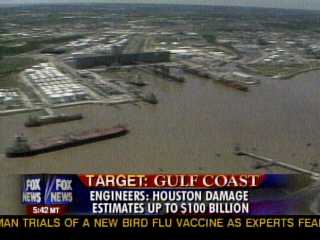
This oil-port facility may well disappear.

I can’t imagine what kind of weather event would require evacuating the Nashville metro area, where I live. It’s possible, I think, that an earthquake in the New Madrid fault in far-eastern Missouri could have deleterious effects here, but evacuation because of it? Don’t see it. (An earthquake there in 1811 was the most severe ever in historical time in North America and literally changed not only the course of the Mississippi but of American history.)

But one lesson I would think worthy to learn from both the excruciations of the evacuations of New Orleans and now Houston is to leave sooner, not later, or at least as soon as possible. Some motorists fleeing Houston today have been stuck for 14 hours and have run out of gas.
Hurricane Rita is now the third-most powerful Atlantic hurricane ever.
Aircraft recon earlier reported a central pressure of 897 mb. This makes Hurricane Rita the third most intense hurricane ever record in the Atlantic. This places Rita behind Gilbert in 1988 with 888mb, and the 1935 Labor Day Hurricane with 892 mb. Last month Hurricane Katrina recorded 902 mb.
If there is any good news it is that Rita’s pressure subsequently climbed slightly to 907 mb.
Texans on the Gulf coast are getting out of dodge, you betcha. Meanwhile, the predicted landfall of the storm appears to have moved eastward and the center is now predicted to move ashore not far from the Louisiana border early Saturday morning. In the two days left we’ll have to see whether the track continues to drift east. Even if it does, it appears that it won’t center on the New Orleans region as did Katrina three weeks ago. But Houston still looks to get slammed even if the eye misses the city.
Update, mid-afternoon: Rita is now classed as Cat 4, but a radio hurricane interviewee said it is mostly because it is so huge. It still packs very destructive force.
Two thousand words worth of pictures explaining the difference between the evacuation of New Orleans and Houston.
However, I would add that even a fool usually learns from his own mistakes. The wise one learns from the mistakes of others. Surely this works to the Texans’ advantage.
Will Rita, currently a Cat 1 ‘cane, increase in strength as it moves west into the Gulf of Mexico? Once again, I refer you to Stormtrack blog for the inside story.
This started as an email from me to Don Sensing and several other friends. I wrote it on Sept. 11, a week after my Tenn. Army Guard unit’s departure for the Gulf coast. We had returned just two days before from three weeks of an exercise in Bulgaria, where I haved spent a lot of time over the past several years.
The 11th was our mildest day so far though still much was going on. It seems Sunday is still a day of rest even in a disaster zone! I was out yesterday mornng on the ground in Long Beach and Pass Christian which are the hardest hit areas. There are still bodies out there, we suspect about 20 in the Long Beach Walmart and a few float onto the beach every day. I was on patrol last night checking our troops and gettting a sense of night time activity in our area of operations. We were out from 12:30 a.m. until about 4 a.m. and it was quiet except for law enforcement and military traffic. That’s a good thing.
The troops continue to have high morale about the mission but are getting tired with 12 hour days every day and the carnage is taking its toll on them. My staff works 12 hour days and the primary staff (including self) works 14 to 16. We have several Iraq and Afghan war vets and all of us have some levels of post-traumatic stress and the carnage here affects that. What you can’t sense in the pictures are the smells and sometimes they are overwhelming with the sewage, natural gas leaks, garbage and bodies in the rubble.

(Ignore the uncorrected date print!)
The locals are so appreciative. They give us thumbs up, take our pictures as we drive by, and are bringing plates by the handful of gumbo and bar-b-que to our soldiers on traffic control points or as they patrol by. Many of our guys have been moved to tears as people who have lost everything bring them food, buy them pizzas, or pay for their sodas and snacks at the few opne convenience markets. It is really overwhelming. A common refrain from the locals is, “We know we are going ot be okay because the Guard is here now.” So please pardon a little bit of bragging or pride on my part.
Our Guard troops are truly magnificent and represent the very best of america. I am humbled to serve my soldiers. The sense of unity here is strong and it is amazing to see the flag flying in yards that now consist of nothing but a slab, debris and clothes in a tree.

Yes we can see God in all things even here.
Things are improving by the day and official discussions have begun about when we will leave. Currently the “talking date” is September 30. Please continue to pray for all of those affected by this disaster. It is unprecedented.
On the second anniversary of Sept. 11’s attacks I was in Kabul. Now on this 4th anniversary I am in a domestic disaster zone. Our world has changed. Weird as it may sound there is no place I’d rather have been on these two anniversary dates.

| S | M | T | W | T | F | S |
|---|---|---|---|---|---|---|
| « Apr | ||||||
| 1 | 2 | 3 | 4 | 5 | ||
| 6 | 7 | 8 | 9 | 10 | 11 | 12 |
| 13 | 14 | 15 | 16 | 17 | 18 | 19 |
| 20 | 21 | 22 | 23 | 24 | 25 | 26 |
| 27 | 28 | 29 | 30 | 31 | ||
19 queries. 0.512 seconds