
RSS/XML |
 |
Essays |
Main Page |
Disclaimer |
|
|
Essays |
Main Page |
Disclaimer |
|
|
Essays |
Main Page |
Disclaimer |
|
FNC reports:
An American GI assigned to one of the harshest posts in Iraq had a simple request last week for a Wisconsin mattress company: send some floor mats to help ease the hardship of sleeping on the cold, bug-infested ground.
What he got, instead, was a swift kick from the company’s Web site, which not only refused the request but added insult to injury with the admonition, “If you were sensible, you and your troops would pull out of Iraq.”
Army Sgt. Jason Hess, stationed in Taji, Iraq, with the 1st Cavalry Division, said he emailed his request to Discount-mats.com because he and his fellow soldiers sleep on the cold ground, which contains sand mites, sand flies and other disease carriers.
In his email, dated Jan. 16, 2007, he asked the Web-based company, registered to Faisal Khetani, an American Muslim of Pakistani descent:
“Do you ship to APO (military) addresses? I’m in the 1st Cavalry Division stationed in Iraq and we are trying to order some mats but we are looking for ships to APO first.”
The reply he got basically said get stuffed. See the FNC site for the rest of the story.
Unbelievable.
Because you get to do this.
Of course, it’s fun the rest of the time, too.
I have just completed a rotation as a National Guard officer working in the Yuma, AZ sector of Operation Jump Start. Operation Jump Start is the manifestation of President Bush’s plan to provide increased border security to stem the flow of illegal immigration.
I must admit that I had personal reservations about the role of the National Guard in this mission. There are no hostilities on the border. There is not a natural disaster. There is no rioting. These are the typical roles for the Guard - temporary emergencies. I feared that border security would become a permanent mission for the Guard keeping us away from home when we might be needed for state emergencies and causing a decline in our combat readiness for our national war time missions.
But then I heard the words of an experienced and wise Non-Commissioned Officer (NCO). He said “Taking care of the nation is our business.” That’s the bottom line. And he is right. So often it takes the words of an NCO to put things simply and provide common sense.
My rotation on the border has given me a chance to perceive more clearly the intellectual case and the practical case for how the business of taking care of the nation by the National Guard includes protecting our borders. That may be for only a couple of years or even a couple of decades or more. But it must be done and somebody has to do it.
The Intellectual Case
As I have thought about this border mission I have been struck by the Catholic Church’s definition of peace. The Church defines peace as “a tranquility of order”. And it occurs to me how our immigration policy is in such disorder. We all acknowledge there is a lack of controlled flow of immigration. Folks who make it legally to the US must wait years and endure bureaucracy to remain here legally and attain citizenship. While at the same time millions come across illegally and stay illegally. This causes a disruption and a strain in our society. And it is unjust. There is no order about it and no “tranquility” about it.
During this operation I have seen firsthand the trials that illegal immigrants endure. I have heard the statistics of the illegals who die in the desert, who are robbed by bandits just as they are about to cross. The “facilitators” on the other side of the border charge thousands of dollars telling illegals that once they cross the border they will reach another facilitator or roads in only a couple of hours. In most cases there is no other facilitator and it takes many more hours and often days to reach civilization. By that time the illegals are dehydrated, starving and many die.
The “facilitators” on the Mexican side will bring a group of illegals to a staging area just short of the border. Then as the facilitator goes ahead alone to “check out the crossing” a pre-arranged group of bandits descend upon them, beat and rob them. The “faciliator”, who is in on the game, returns feigning dismay at what happened in the short time he was gone.
These cases are a moral outrage and the lack of order in our immigration policy is significantly responsible. Our open borders encourage this outrage. This disorder on the border is a violation of the definition of peace. In an intellectual sense - and in a real sense - there is a war on our border. Peace must be restored.
The Practical Case
My experience as a participant in Operation Jumpstart has opened my eyes to the fact that we can protect our borders effectively. We can create a near-impenetrable virtual wall through the combination of technology, human presence in observation posts and patrols, and physical walls in critical places. This works. It deters border crossings and channelizes would-be crossers to either legal crossing sites or places where we can nab them more quickly and effectively. The US Customs and Border Patrol does amazing work as shorthanded as they are. The cooperation between that agency and the National Guard is a model of various entities working together for the good of their country.
Enforcement of the border must come first. A general amnesty will only make things worse as history has proven. Prior to the last amnesty that was granted in 1988 the vast majority of illegals was men seeking to come over to work so they could send money home to family. Since that amnesty the illegals have included millions of women and children who have accompanied their men in coming over not to work but to settle here. And many have suffered and died and been robbed in the process. Our social network has not been prepared to handle them. And it takes responsibility away from their home nation for taking care of their own citizens - they can simply send their “excess” citizens to America. Imagine what will happen if we repeat that general amnesty again. The floodgates will open even wider than they did in 1988.
We can welcome immigrants and we should. Many need the opportunities and asylum available in America and we need them. But we must have order in our system; it must be legal and there must be no tolerance of illegal entry. An orderly system protects both our nation and the immigrants seeking to come here. We have a moral obligation to restore order to the system.
ABC News: About 300 Alaska-based soldiers sent home from Iraq just before their unit’s deployment was extended last month must now go back, the Army said Monday, setting up a wrenching departure for troops and families who thought their service there was finished.
The soldiers all from the 172nd Stryker Brigade are among the 380 troops who had gotten home to Fort Wainwright when Defense Secretary Donald H. Rumsfeld ordered the unit to serve four more months. The remaining 80 will not have to return to Iraq. …
The bulk of the 172nd Brigade was still in Iraq when Rumsfeld extended their deployment as part of a plan to quell the escalating violence in Baghdad. Overall, the brigade has about 3,900 troops.
Another 300 soldiers from the unit had left Iraq and gotten to Kuwait, and were about to board flights home when they were called back.
Before Monday’s announcement, the troops who had already returned home to Alaska had been told that decisions on their fates would be made on a case-by-case basis.
Army officials said they don’t recall another time during the three-year-long Iraq war when the Pentagon so quickly recalled soldiers who had served a year on the battlefront and gotten home.
The 300 soldiers recalled from Alaska on Monday got to spend between three and five weeks at home, and will head back to Iraq in the next two weeks. Most of the brigade is expected to leave Iraq by the end of the year, although Army spokesman Paul Boyce said Monday there are no assurances the unit’s stay will not be extended again.
The Stryker is a six-wheeled combat vehicle that has proven extremely effective in fighting the insurgents, especially at night.

Leave a caption as a comment! Winners will be announced Thursday or so. Grand prize is the satisfaction of a job well done.
The first-person story behind the photo, and what the child said to the soldier, is below the fold.
(more…)
Say buh-bye, troops!
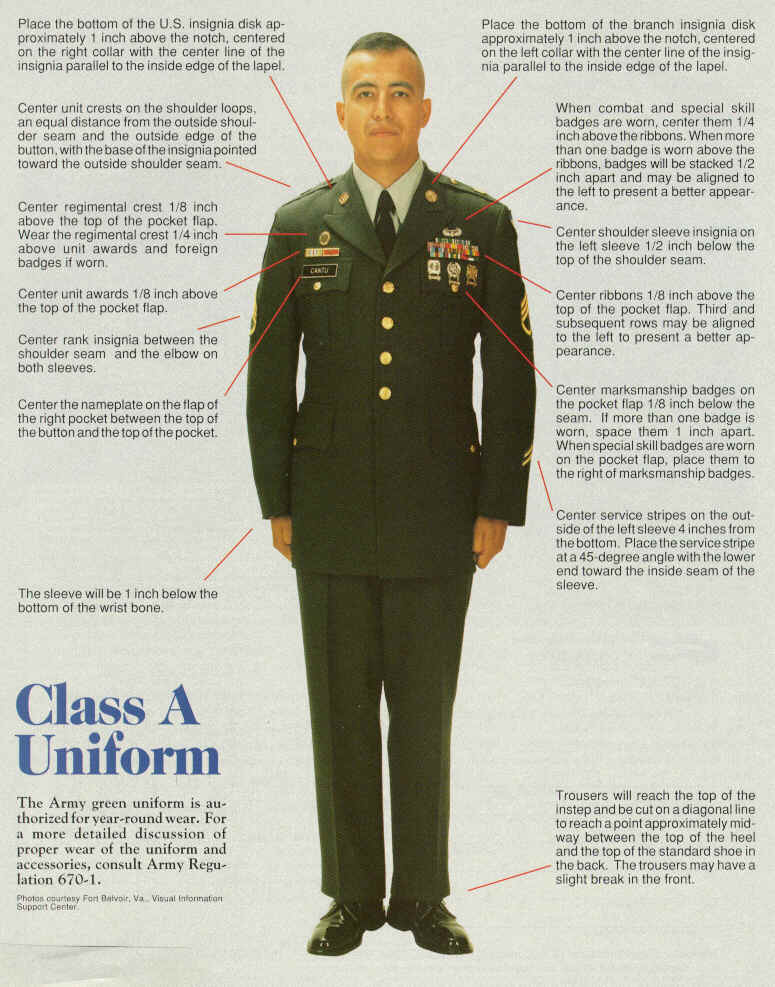
The present Army Class A (coat and tie) uniform has been around since 1954, making it perhaps the longest-lasting uniform the Army has had. But it’s being eliminated altogether with no new uniform to take its place.
Instead, the present Dress Blue uniform is being renamed the Army Service Uniform and with minor modifications in tailoring and material will be the standard coat-and-tie uniform for enlisted soldiers and officers.
The Army’s information page, with photos, is here.
Of course, the new service uniform will look like crap with the black beret (never wear black and blue together!) so the Army will re-introduce the saucer cap as part of the service uniform ensemble. I am convinced, based on no evidence but on the years of my career, that field-grade officers hated wearing the beret with the green Class A’s because the old green saucer cap for majors and above had “scrambled eggs” on the bill - gold-colored laurel leaves. Having retired as a field-grade officer myself, I don’t blame them. I wore the field-grade cap exactly one time in my career, though; in fact, it was borrowed and I never bought one. I always wore the flat cap, which looked great with the green Class A but would look silly with the blue uniform, even made of matching material.
At any rate, no soldier is going to object to reducing the number of uniforms s/he has to buy, thus simplifying their lives and reducing their costs of upkeep. Soldiers who already possess a Dress Blue uniform (meaning all officers and most senior enlisted personnel) won’t have to replace it with the slighty-retailored Service set. And blue is the most-used color of Army uniforms in its history, dating to the Revoilutionary War, so it has the weight of tradition behind it. All in all, a good move by the Army’s leadership.
Hat tip: Richard Heddleson, via email.

| S | M | T | W | T | F | S |
|---|---|---|---|---|---|---|
| « May | ||||||
| 1 | 2 | |||||
| 3 | 4 | 5 | 6 | 7 | 8 | 9 |
| 10 | 11 | 12 | 13 | 14 | 15 | 16 |
| 17 | 18 | 19 | 20 | 21 | 22 | 23 |
| 24 | 25 | 26 | 27 | 28 | 29 | 30 |
19 queries. 0.498 seconds
