
RSS/XML |
 |
Essays |
Main Page |
Disclaimer |
|
|
Essays |
Main Page |
Disclaimer |
|
|
Essays |
Main Page |
Disclaimer |
|
Recently declassified documents released by the National Archives reveal that within months after the lopsided American victory at the Battle of Midway in early June 1942, the US Navy high command had concluded the battle had been a “grave mistake in advancing America’s security interests over the long term.”
The unsigned monograph, the result of an intelligence study apparently undertaken by command of Adm. Ernest King, Chief of Naval Operations, said that
… the attack against the Japanese fleet was enormously successful on the day [it occurred], but repercussions of the destruction of four major Japanese aircraft carriers and a heavy cruiser may not be worthy of the celebrations and optimism the battle resulted in.
The report notes the loss of Japan’s light carrier Shoho in May 1942 in the Coral Sea, coupled in the same battle with the significant damage to the Japanese fleet carrier Shokaku and the near-total destruction of the air wing aboard the carrier Zuikaku. These losses, the report noted, were not severe enough to offset the destruction of the American carrier, USS Lexington.
The undated report was apparently completed in the spring of 1943. It concluded that the destruction of the four Japanese carriers and the heavy cruiser at Midway “may turn out to be a true Pyrrhic victory” for the United States.
We assess that the Battle of Midway is shaping a new generation of Japanese leaders and operatives; perceived Japanese future success in the Pacific against U.S. Navy forces would inspire more Japanese to continue the struggle elsewhere.
The Pacific conflict has become the ’cause celebre’ for the Japanese, breeding a deep resentment of America’s involvement in the Pacific and the Asian mainland and cultivating supporters for a global Bushido war movement. Should Japanese units leaving battle zones perceive themselves, and be perceived, to have failed, we judge fewer Japanese will be inspired to carry on the fight.
The report went on to predict that fighting in the Pacific would intensify, increasing American casualties as Japan continued to pour troops and materiel into the operational areas.
In response to the release of the 63-year-old study, the New York Times reported, “Pacific War assessed as quagmire, WW2 intelligence estimate reveals.”
Looking for inquiring minds and key-tapping fingers - your chance to post here!
Islam! Democracy! Liberty! That’s the topic (no, not “Democracy! Whiskey! Sexy!”). I am inviting readers to submit their thoughts for publication, under your byline, on this site.
I argued yesterday that democracy was not incompatible with Islam, qua Islam, but that the way Islam is practiced in various places around the world made it incompatible in some places and more compatible in others, though nowhere is a Muslim country’s democracy (where found) anything like that of the United States.
It wasn’t the first time I have written on the topic. In April 2004 I posted the following, taking a more contrary view.
This basic tenet of Islam means that the concept of democracy - the “people ruling” - has no natural place in Islam. Democracy in Muslim countries is literally alien to the religion. Last October, the prime minister of Malaysia, Datuk Seri Dr Mahathir Mohamad, gave the opening address at the 10th Session of the Islamic Summit Conference. In delineating the problems facing Islamic countries today, he said, among others things,
… we also accepted the western democratic system. This also divided us because of the political parties and groups that we form, some of which claim Islam for themselves, reject the Islam of other parties and refuse to accept the results of the practice of democracy if they fail to gain power for themselves. They resort to violence, thus destabilising and weakening Muslim countries.
The rift between the concepts of the ideal society of Western and Islamic thought is enormous. Like an earthquake fault, the pressures and friction were not wholly visible for decades, but they exploded violently. As many others and I have said for a couple of years now, the contest between “the West and the rest,” in Roger Scruton’s term, will endure for a long time to come.
So where are we on this?
One thought that deserves consideration is Bill Quick’s comment that however much Islam might be compatible with some sort of democracy, Islam is not compatible “with individual liberty, the idea that the individual posseses rights that transcend the powers of the government under which he lives.”
What do you think? Please email me your posts (try to keep reasonably brief) and I’ll post as many as I can here. If you can email them in HTML format, with hyperlinks and blockquotes, where applicable, I’d be most grateful.
Please bear in mind I really have no time to edit, so posts using profanity, even in quotations, won’t get published. Just [snip] them out. Be collegial! Discuss the character of ideas, not of persons. Have fun!
Email submissions to gunner20-at-comcast.net, obviously replacing the -at- with @.
I have had both the privilege and the angst of serving as a combatant in Afghanistan. I have also had the privilege and tension of serving as an ordained Christian minister at home. I have been caught in the literal and spiritual crossfire of contradictory questions: What is peace; what is war? Is peace simply the absence of war; is war a tool of love to protect human dignity from an immoral peace? How moral are we when we go to war; how moral are we when we don’t go to war?
During my service as both soldier and minister, I have seen the beautiful truths of this world as well as the ugly. We would all like to think that there should be only beauty in the world. But we have to face the ugly truth of this world. And the truth of this world is that evil exists. We have not only to look at the world today but through the window of history to see that.
Hitler was real. That was truth, and it was ugly. As I saw the after-effects of his reign when, in the 1980s, I visited the concentration camp in Dachau, I saw ugliness. Stalin was real. That was truth, and it was ugly. As I have spoken to survivors of purges and the gulags in Russia, as I have seen the environmental and economic damage to Russia and Eastern Europe, I saw ugliness. And in my own homeland, slavery in the South was real. That was truth, and it was ugly — and its damage is lasting.
I have seen evil and brutality in all of these places, and I’ve seen it in Afghanistan.
From the fires of evil, however, I have seen the light of hope. And it is showing the way to peace. I have seen it in a free Germany, far from the Germany of Dachau, where millions of Muslims flock to find jobs and freedom. I have seen it in Russia and Eastern Europe, economies taking off, people speaking and voting without fear of punishment. I have seen it in the South, the birthplace of America’s civil rights movement, where so much good has happened (and still much more is needed).
I’ve seen it in Afghanistan.
I have seen hope in the face of the safe house manager who told me of the miracle of the years following our entry into Kabul. I have seen it in the face of the Afghan orphan girl who told me she wanted to be a doctor and the one who said, “I will be president.” I have seen it in the face of a young lady from Farah province in Afghanistan, now serving as an elected parliamentarian.
I have seen it in the refugees returning to Afghanistan and in the Iraqis holding steadfast in their towns and villages. I have seen it in the Iraqi recruits who get back in line after bombs have taken their friends, their cousins and their brothers. I have seen it on the purple fingers of men — and women — who have voted in Afghanistan and Iraq.
I have seen hope in the uniforms worn by soldiers I have known and served with. The Afghans and Iraqis we have served have seen that hope in my uniform. I see that hope in my own children at home in America.
We are at a possible turning point in this war — a critical moment of decision. It is not easy. Will we persevere or run? Do we really think we will have lasting peace if we “withdraw” from this war? How moral will we be if we fail to persevere at this critical time?
If there is to be a time of true peace, then now must be a time for war — a war that is a last resort for a time of lasting peace.
You can download a full quality version here:
http://www.rc-cam.com/forum/index.php?showtopic=1066&st=20
music: Enigma - Lord Of The Dance - Celtic Dream
The United Methodist Church is asking its clergy and laity to take an online survey on the state of the denomination.
Via Glenn Reynolds, I read this post by Dean Esmay disputing the assertion that Islam is incompatible with democracy. I agree with him, but his argument is flawed. He writes,
This very statement-that Islam is incompatible with democracy … would be akin to, in World War II, declaring ourselves at war with “Germanic People,” “Latin People,” and “Southeast Asians.” Not Nazi Germany and Mussolini’s Italy and Tojo’s Japan. No, we would have declared that we were at war with anyone of Germanic or Latin descent, and anyone who happened to be short, yellow, and slant-eyed (to put it rudely and crassly).
Yes, Dean, it is rude and crass, all the more so because it is inapt and not applicable. Your analogy is a non-sequitur.
I am surprised because Dean has done a lot of studying and writing about Islam. But here he has equated a religious identity with an ethnic identity. This is crude stereotyping at its worst. Muslims are, like the Christian children’s song says of the Church, “red and yellow, black and white.” And Dean knows this.
To claim that Islam is incompatible with democracy is not akin to saying that Germans or Japanese are incompatible with democracy. It is like saying that Nazism or Bushido Shintoism were incompatible with democracy. Which they absolutely were.
But is Islam, qua Islam, incompatible with democracy? Actually, Dean never gets around in his teardown of Michelle Malkin to answer the question except to affirm that it is compatible. I think answer is not so clear as Dean makes it to be. Or, perhaps the answer is “it depends.”
Islam is compatible with democracy in some places in the world and not in others. It’s compatible in Turkey and India and some southwest Pacific places, but not compatible in Saudi Arabia or Egypt. The Iraqis are trying to make a go of it, but we don’t know whether they will succeed. And even in places like Turkey, democracy is decidedly not Jeffersonian.
Let us not fall into the trap of qualifying the answer by using the term, “Western-style” democracy, since that term is highly inexact. British democracy is not the same as American democracy and neither are very much like French democracy. They all share enough commonality that it is sensible to group them together (for example, an Enlightenment heritage) as long as we remember they are significantly dissimilar.
So, at the risk of sounding trite, whether Islam is compatible with democracy depends on what the definition of “democracy” is. And even in Europe and America, that definition has changed quite a bit over the last couple of centuries in Europe and America. Remember that at first, neither women nor Americans of African descent could vote in America and US senators were selected by state legislatures rather than directly elected by the state’s voters. In England until very recently, half the Parliament consisted of members born to the office and until Queen Victoria’s reign, the monarch really was the sovereign state embodied.
We should not expect that in any Muslim country today that democracy will mirror America’s. Tribal and clan identity will continue to be ways most of those societies are organized for a long time to come. Their democratic institutions, wherever they develop, will reflect that.
But let us be frank, at least with ourselves: the “problem” of the Muslim world, vis-a-vis democracy, resides in the Arab countries. (Even Iran is more democratic than Arab lands.) And the problem in those countries is not that they are “too Muslim” or not Western enough, but that they are not Muslim enough and they are too Western.
Prof. Bernard Lewis explains:
[I]t is helpful to step back and consider what Arab and Islamic society was like once and how it has been transformed in the modern age. The idea that how that society is now is how it has always been is totally false. The dictatorship of Saddam Hussein in Iraq or the Assad family in Syria or the more friendly dictatorship of Mubarak in Egypt-all of these have no roots whatsoever in the Arab or in the Islamic past. Let me quote to you from a letter written in 1786-three years before the French Revolution-by Mssr. Count de Choiseul-Gouffier, the French ambassador in Istanbul, in which he is trying to explain why he is making rather slow progress with the tasks entrusted to him by his government in dealing with the Ottoman government. “Here,” he says, “things are not as in France where the king is sole master and does as he pleases.” “Here,” he says, “the sultan has to consult.” He has to consult with the former holders of high offices, with the leaders of various groups and so on. And this is a slow process. This scenario is something radically different than the common image of Middle Eastern government today. And it is a description that ceased to be true because of a number of changes that occurred.
Those changes included modernization in the early twentieth century, when,
… rulers decided that what they had to do was to modernize or Westernize. Their intentions were good, but the consequences were often disastrous. What they did was to increase the power of the state and the ruler enormously by placing at his disposal the whole modern apparatus of control, repression and indoctrination. At the same time, which was even worse, they limited or destroyed those forces in the traditional society that had previously limited the autocracy of the ruler.
Canadian journalist David Warren grew up in Pakistan. He wrote that Arab leaders most often,
… became socialists of one kind or another, for in the world of only a few decades ago, that very Western ideology of ‘socialism’ could still be presented as the coming thing, as a ‘scientific’ thing, the cutting edge of progress. Most came to believe that the best way to modernize their societies was through central planning, and that their own class was in effect the socialist vanguard.
But socialism worked even worse in the Arab countries than it worked in Europe: “None of [their] five-year plans ever worked. And the only thing that did work was the elites clinging to power, trying to Westernize or modernize their societies with increasing frustration.”
The second disaster for the Arab people was the opening of Syria-Lebanon to Nazism in 1940 when Vichy France allied itself with Germany. Since that area of the Middle East had been under French control, the Nazis walked in and Nazism took root.
Prof. Lewis also discusses the part Wahhabism has played in oppressing Muslim peoples, first in Arabia but now, flush with petrodollars, almost everywhere else in the world that Islam has gained a foothold. yet Wahabsim is not from the historical mainstream of Islam and absent oil wealth would still be an obscure, clan-based cult.
Bottom line: Islam as practiced and preached in much of the Muslim world today is incompatible with democracy of any recognizable kind. And Islamism (Islamic fascism) is no more compatible than Nazism. But the US, Britain and the West should not try to nurture democracy in Iraq or elsewhere that cleaves to a mainly Jeffersonian model. That is to guarantee failure. Prof. Lewis concludes,
The outlook at the moment is, I would say, very mixed. I think that the cause of developing free institutions-along their lines, not ours-is possible. One can see signs of its beginning in some countries. At the same time, the forces working against it are very powerful and well entrenched. And one of the greatest dangers is that on their side, they are firm and convinced and resolute. Whereas on our side, we are weak and undecided and irresolute. And in such a combat, it is not difficult to see which side will prevail.
I think that the effort is difficult and the outcome uncertain, but I think the effort must be made. Either we bring them freedom, or they destroy us.
Quite so.
Update: More thoughts here and an invitation to have your own thoughts posted under your byline on this site.
If I could, I’d buy my gasoline from 7-11 stores. Sadly, I find none listed on AnyWho.com for the Nashville area.
Several weeks ago I was pleased to welcome John Krenson as a columnist to One Hand Clapping (now an inapt blog name, I suppose). John is a close friend, a field-grade officer in the Tennessee Army National Guard, and Afghanistan veteran and a permanent ordained deacon of the Roman Catholic Church.
He is also the author of the book, Crossfire, released earlier this month.
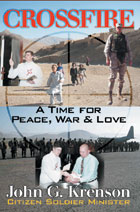
“This story is really about two wars,” John explains. The tension between Christian discipleship and the secular duties of military service has been a matter of painful, often vitriolic debate among Christians for many centuries. Many Christians deny that there really could be such a thing as “just war,” that war even for apparently just reasons can have no basis in Christian faith. Others respond that that the Scriptures teach clearly that Christians are to work for justice among the nations and that sometimes aggression by nations can only, even if regretfully, be met with force; that being so, even faithful Christians may take up the sword.
I know of no one who has struggled with this issue in heart, soul or mind more seriously or with greater sensitivity that John Krenson. Were John a military chaplain, the tension he describes so eloquently would be much lessened, even vanished. But John serves his country armed with weapons of death even while he serves his Church and the Prince of Peace. To say that the tension between these two offices caused him little concern is completely to mistake John’s moral character and to be blind to the real and enduring struggle of his soul.
“Duty, honor, country,” is the Army officer’s credo and moral compass. To read John’s story is to be taken to greater, more valuable understandings of how duty can be painful and sometimes unclear, how honor can be retained even in the fog of war and how country can be ably served even by a faithful man of Christian devotion.
John’s story is universal but also unique – universal because he shares in his soul the long tradition of Christian unease with the blunt instruments of politico-military policy, unique because his struggle is specifically that of a patriotic American who has pledged allegiance both to flag of country and the Kingdom of God.
Our nation and the Church are fortunate to be served by John Krenson. This book needs to be read by every thinking American, especially by those who struggle with the tensions between Christian faith and patriotism to country.
In Nottingham a new cemetery has just opened that will use Muslim rules of burial for everyone, Muslim or not.
A new, $4.7 million cemetery in Nottingham is the first public graveyard in the UK to have all its burial plots aligned with Mecca and to inter those of all faiths in the Muslim tradition.
All headstones at the 40-acre burial site will face northeast, enabling the dead to look over their shoulder toward Mecca, the manner prescribed for followers of Islam in the UK.
Church leaders have criticized the decision by local officials, saying that imposing a Muslim model on Christians, who traditionally are buried facing east, is discriminatory. …
Steve Dowling, the official with the Nottingham city council, said that he met with the city’s Cemeteries Consultative Committee, a multi-faith group, before deciding on the Islamic burial plan. He made his decision, in part, on esthetics and the need for symmetry.
“For people of the Muslim faith this fits in with a religious requirement, but it will also ensure a tidy appearance for the site,” he said. “People can choose to be buried facing another direction but if they do not specify that, they will be buried facing northeast. The vast majority of people do not express a preference.”
Nigel Lymn Rose, past president of the National Association of Funeral Directors, said he had been surprised when he asked Dowling if the new cemetery had made accommodations for Muslims and Dowling answered, “Oh yes, we’re burying everyone so they are aligned to Mecca. It will make things easier.”
“It’s one thing to be buried facing northeast because that is the way the cemetery lies, or the plot within it – it is quite another thing to learn that you have been buried facing that direction because it follows Islamic law,” said Rose.
Even Raza Ul Haq, imam at the Madni Masjid Mosque, is bewildered by the decision.
“It is part of our religion for the dead to be aligned with Mecca. It is very important. But for Christians, if they want to face somewhere else we support them,” he said.
Muslims make up less than five per cent of the Nottingham region’s 500,000 population.
I’m trying to imagine the bureacratic hoops next of kin will have to jump through to request burial facing another direction. As for Raza Ul Haq, he sounds like the only straight-up guy involved with the whole thing.
Consider this report:
Pajamas Media, in the course of a casual conversation with a Marine Corps information officer who tracks the number of embedded reporters in Iraq, learned the real number of embedded reporters covering the Iraq story on September 19, 2006. It was, according to the officer, a fairly typical day. To illustrate his point, he provided Pajamas Media with the illustration he uses to brief with on the state of media embedding in Iraq.
What was that number? Take a guess and then see the truth. No peeking.
If you guessed 9 reporters, you guessed right.
Of the nine, four were from the defense department’s own media operations, Stars and Stripes and Armed Forces Network, and one was from Poland. There was one each from the Charlotte Observer, the BBC, AP and RAI.
Note: this is not the number of reporters in Iraq, it is the number embedded with units carrying out operations. As PJM adds, there were scores of “reporters hunkered down in the hotels and other locations under the rubric “Baghdad News Bureaus.’” But those reporters are not reporting news they personally cover other than inside their own narrow bubble. Strategy Page reports,
Most journalists are in the Green Zone, or some well-guarded hotel. There, they depend on Iraqi stringers to gather information, and take pictures for them. In reality, these reporters could do this from back home, and many more media organizations are doing just that.
Nothing new about using local stringers in dangerous areas. It’s common sense, given that the bad guys are in the habit of kidnapping, or just killing, foreign reporters. The problem is, the pool of available Iraqi talent is mostly Sunni Arab. Many of these folks side with the bad guys. And all Iraqi journalists, especially those working for foreigners, are subject to intimidation, or bribery. While some of the foreign reporters may be aware of all this, some aren’t, and many of the rest don’t care. The truth won’t set them free, but supplying stories their editors are looking for, will.
Those cowardly, profit-motivated reporters and news organizations are just screwing the troops, right?
Well, not so fast.
You might think it’s easy to gain permission to embed with a combat unit. After all, as Strategy Page also notes, “U.S. troops continue to be mystified at the odd reporting coming out of Iraq. What the troops witnessed is not what reporters are sending back.” So common sense would say that the military would embed as many reporters as it can and plead with news organizations to send more.
But there is, as Paul Harvey likes to say, “the rest of the story.” Here is San Antonio Express’s reporter Sig Christenson, with lengthy embedding experience since OIF began in 2003. He spent the invasion embedded with 78 other reporters in the 3d Mechanized Infantry Division. Did you get that? There were 79 reporters embedded with that single division for the invasion. Now there are nine in all Iraq.
Sig returned not long ago from another embed tour, the most recent of five altogether. Sig blogs for the SA Express and writes,
So how did we go from 79 reporters with the 3rd ID, one of them ABC’s Ted Koppel, to 11 with 147,000 American troops in all of Iraq? You can start with the fact that editors are damned nervous about sending their reporters into Baghdad. This is the town where, morning after morning during our recent reporting tour there, bombs went off by the hour. One day last month the first bomb detonated at 6 a.m. When the third one rocked the town at 8 a.m., I got up from bed in disgust. You don’t need an alarm clock in Baghdad, thanks to insurgents who kill everybody who gets in their way in the name of Allah on the hour and half-hour. Sad and weird, but true, I am sorry to report.
Okay, it’s dangerous to embed, let us grant that, and no reporters or any other civilians have a special obligation to risk death or injury as part of their job. Nor should we discount that assignment editors are understandably reluctant to send one of their reporters to a war zone, volunteers. Those are the facts and the public’s bona fide need to know what is happening doesn’t obviate them.
But that’s not the whole story. DOD’s public affairs office still treats embedding as an ad hoc arrangement.
Almost four years after the Pentagon unveiled the embedding program, there is no clear-cut way to cover the troops in Iraq. I’m an expert on this after having set up embeds for myself and, last year, for photographer Nicole Fruge and reporter Jesse Bogan. There is no simple, one-step process.
You have to send e-mails to the Combined Press Information Center in Baghdad. You have to e-mail local commanders with units you wish to embed with, and they have to accept you. You have to e-mail the Air Force to set up the flights. At some point, you deal directly with someone from the Air Mobility Command, which flies cargo and people into and out of Iraq. This time I also had to e-mail the Air Force Theater Hospital in Balad and Landstuhl Regional Medical Center in Germany so we could do the reporting on a series about military medicine. If I do an embed next year, I’ll have to start with a new set of public affairs officers because all the old ones have left Iraq.
I’ll also have to get a new CPIC identification card. Been there, done that.
Sig writes a lot more about this issue. Having been an Army public affairs officer at the Pentagon for three years, I can tell you that until the top military and civilian bosses there make facilitating embeds a priority for PAOs and commanders, nothing will be done to change the stifling bureacracy that Sig explains. For DOD, that means Donald Rumsfeld will have to be the engine of change (fat chance). In World War II commanders weren’t asked whether they wopuld accept a reporter, they were told. Yes, I know the media were different then - no one could seriously ask which side the Associated Press was on, for example, and there was wartime censorship of news reports. But the mechanism of embedding was well established and smooth. And that’s what’s broken now.
Sig is doing something, though. He is a founder of Military Reporters & Editors, which,
… will host an Embedded Reporting Summit at the close of its 5th annual conference, to run Oct. 26-28 in Chicago. Military officers and war correspondents will pore over the issues and see how things can be fixed. MRE will later issue a report calling for a series of changes in the way embedding is handled by the Pentagon. We’ll do that because we believe the media and military have good reason to improve the system, that modifications would benefit everyone concerned.
Read Sig’s blog, it’s well worth the time. Page on down and read his interview on the scene with soldiers of Iraqi army unit.
I suppose there could be a point to this kind of test drive, but darned if I know what it is.
It would be great, but I’ll believe it when I see it.
Seasoned scientists at EEStore say they’ve created a battery made of glass- and aluminum-coated ceramics that could allow electric motors to completely replace the internal combustion engine. The inventors, erstwhile Xerox PARC and IBMmers, boast about the car’s efficiency, saying it’ll be so cheap it’ll be as if gas cost 45 cents per gallon, will drive 500 miles on nine bucks’ worth of electricity, and needs just five minutes to completely recharge. Plus, the company’s CEO says, “a four-passenger sedan will drive like a Ferrari.” Tall claims, EEStore.
Meanwhile, Feel Good Cars, those Canadian electric carmeisters whose ZENN electric car is pictured above, vow to make this technology roadworthy by 2008. Oil companies, get out your checkbooks, but you’d better have some phat cash ‘cause these EEStore guys are well-financed.
“Seasoned scientists?” That’s a new one.
Nine hundred pennies to go 500 miles is 1.8 cents per mile. At 45 cents per gallon, that works out, I think, to 25 miles per gallon equivalence.
Ah, but what will this car cost? Maybe the electricity costs works out to 45 cents/gallon equivalent, but if I have to make up the “missing” $2 per gallon just to buy the thing, it’s no bargain. As people learn who do the math comparing, say, a Toyota Highlander Hybrid with the conventional model, it takes many tens of thousands of miles to make back in fuel savings the extra money back they spent in purchase price.
What if the price difference between the “green” car and the conventional one is much less? Consider Saturn’s Vue Greenline , priced at only $2,000 more than the conventional model, abouit half the price delta than competitors. But it’s not the same sort of hybrid drive. Basically, the Greenline uses an electric backup system to enable shutting down the gasoline engine when the vehicle isn’t moving. The electric component does not drive the wheels of the Greenline as it does in the famous Prius or Highlander hybrids.
Married to a 2.4 liter, four-cylinder ECOTEC engine, the BAS [Belt Alternator Starter - DS] system consists of an electric motor/generator and “sophisticated engine controls” (a computer, perhaps?) that turn the internal combustion engine off at idle and restart it upon demand.
A 36-volt nickel-metal hydride (NiMH) battery stores energy from regenerative braking and assists the existing 12-volt electrical system. Passenger comfort features such as air conditioning and stereo and other accessory systems (headlights, windshield wipers, etc.) remain functional while the engine is stopped, using juice supplied by the 36-volt system.
EPA mileage for the Greenline is 27 city, 32 highway, compared to 22/27 for the conventional Vue. While its fuel savings relative to the conventional Vue are not as great as dual-drive hybrids, the cost difference of $2,000 is so much less that “we expect consumers to get a real payback on their initial investment over the life of the vehicle,” according to GM.
However, Fueleconomy.gov rates the annual fuel cost for the regular Vue at $1,564 and the cost for the Greenline at $1,294, a savings of $270, based on 15,000 annual miles and a fuel price of $2.50 per gallon.
That means it will take 7.5 (rounded) years to make the $2,000 back - and gas prices are now well below that $2.50 level, although no one can predict what they will average over that 7.5 years. I try to drive my cars until they are at least 10 years old, so it makes financial sense, on paper, for me to pay that additional $2K. But that seems a long time to amortize such a small amount and I suspect the maintenance and service costs of the Greenline are higher, too. So I’ll pass. (And that doesn’t even consider the opportunity costs of the $2,000.)
Actually, I never buy new cars anyway. A three-year-old, off-lease Greenline might make a lot of sense, but they won’t start to come around until this time in 2009. Were I a new-car buyer, though, unless the price difference between hybrids of any sort and regular cars falls enough to enable me to recuperate the cost in less than five years (preferably no more than four), I’d pass.
Which brings me back to the EEStore’s little plug-in electric car. I know it’s a technology demonstrator, but what I am waiting for is similarly economical car that doesn’t look like it’s a prop for RB, B&B, with 20 clowns about to pile out of it. Give me such a car the size of my Chevy Malibu, or larger, and I’ll be first in line.
The Examiner:
COLUMBIA, S.C. - It is unconstitutional for Sen. Lindsey Graham to serve as a member of Congress and a military judge at the same time, a military court has ruled.
Graham, R-S.C., is a colonel in the U.S. Air Force Standby Reserve, and is assigned as a reserve judge to the Air Force Court of Criminal Appeals.
“One of the purposes served by the separation of powers is that a military accused will not be judged by a Member of Congress,” the decision by the U.S. Court of Appeals for the Armed Forces said. …
The decision, issued Wednesday, came after Airman 1st Class Charles M. Lane, who was convicted of wrongful use of cocaine during a special court-martial, challenged Graham’s qualification to serve on the appellate court, saying it was a conflict of interest.
Seems right to me.
Glenn Reynolds reports thay even the Huffington Post is running away from Hugo Chavez.
Too late. The Republican National Committee has already invited Chavez and Iranian nutcase-in-chief Mahmoud Ahmadinejad to go together on a nationwide speaking tour.
It occurs to me that I haven’t done a posting of just links in a long time, so herewith a belated addition to my “linkagery” series.
1. A joint Muslim-Christian press conference in Washington, DC:
“Violence is not the answer,” said Imam Mahdi Bray, of the Washington DC-based Muslim American Society (MAS).
2. Musharraf: US threatened to bomb Pakistan “back to Stone Age,” if it didn’t support US against Taliban. Bush administration denies charge, sort of.
3. Why is the Internal Revenue Service the country’s “speech police?” Jay Sekulow wants to know. He says the rules of political activity by churches, regarding their tax exemption, have been selectively enforced to favor some political speech over others, and it’s time to let churches exercise their First Amendment rights.
Speaking of which, I posted on Sept. 15 that Tennessee candidate for the US Senate, Democrat US Rep. Haorld Ford, had filmed a campaign as inside his home church in Memphis. Here’s a grab from the ad:

Ford makes only a passing reference to the church, not mentioning it by name, then moves on to cast aspersions on the integrity of his opponent, Republican Bob Corker.
4. Senior al Qaeda leader calls for Muslims to evacuate New York and Washington, DC, says major attack is near. Andi comments,
I’ve discounted al-Qaeda video and audio tapes in recent months, but that does not mean that I’ve discounted the threat. I firmly believe that the United States will see another terrorist attack on its soil, one that could dwarf 9/11, but the tapes and warnings have been numerous since 9/11 and I see no correlation between claims and actions, perhaps that’s by design.
I wrote more than two years ago that Al Qaeda doesn’t threaten what it plans to do, and does do what it never threatened.
5. Coolest Insurgent Act - Stealing almost $7 million from the main bank in Ramadi in broad daylight, then, upon exiting, waving to the Marines in the combat outpost right next to the bank, who had no clue of what was going on. The Marines waved back. Too cool.
There are a lot more categories. Such as why in Kusaybah, “you can’t fight City Hall:”
Bad Guys arrived at the government center in the small town of Kubaysah to kidnap the town mayor… . There were seven of them. As they brought the mayor out to put him in a pick-up truck to take him off to be beheaded (on video, as usual), one of the bad Guys put down his machinegun so that he could tie the mayor’s hands. The mayor took the opportunity to pick up the machinegun and drill five of the Bad Guys. The other two ran away. One of the dead Bad Guys was on our top twenty wanted list. Like they say, you can’t fight City Hall.
Read the whole thing.
6. Why did the chicken cross the road?
Iraqi Makeshift Government: The fact that the Iraqi chicken crossed the road affirmatively demonstrates that decision-making authority has been transferred to the chicken well in advance of the scheduled June 30th transition of power. From now on the chicken is responsible for its own decisions.
WWE: We were asked to help the chicken cross the road. Given the inherent risk of road crossing and the rarity of chickens, this operation will only
cost the US government $326,004.Muqtada al-Sadr: The chicken was a tool of the evil Coalition and will be killed.
There’s more.
7. Briton Gerard Baker, always read-worthy, writes that Europe continues to pathetically cave in to Islamists, even in Afghanistan.
8. Speaking of Afghanistan, Portland, Ore., TV Channel 8 has an outstanding Afghanistan blog. Not just American entries from soldiers there, also lots of information and entries about Canadian troops, too. Like this Canuck trooper:

The Canadians aren’t pathetically caving in, that’s for sure. Remember, their initial force to Afghanistan was the largest combat operation Canada mounted since the Korean War.
Here’s a page of links to videos from Afghanistan.
Lubna Hussain writes in the Arab News of the Pope’s speech and Muslims’ response. Benedict’s remarks were “irresponsible.”
[A]s tension soared over Pope Benedict XVI’s speech it became patently obvious that the pontiff must have been aware of the incendiary potential of his irresponsible remarks well before he made them.
To patronize the collective intelligence of the entire Muslim community by pretending that he “was trying to cultivate an attitude of dialogue and respect” (!) toward us by denigrating our Holy Prophet (peace be upon him) served only to add insult to injury.
The Muslim violence that followed was “abhorrent.”
… It is nothing short of sickening that they continue to commit atrocities in the name of a religion whose very essence is underpinned by tolerance and peace.
It is tragic that we lose our power to reason and allow emotions to dictate our response whenever a situation like this arises. Instead of referring to the teachings of the Qur’an and the Prophet (peace be upon him) a few deviants take it upon themselves to perform atrocities and injustices in the name of Islam.
…It is therefore nothing short of pathetic to watch the mob mentality of some Muslims who, instead of extending this message of peace to the outside world, show a very ugly face when they burn effigies of the pope and attack the lives and property of innocents. Who can blame those who have no understanding of Islam if they cannot see the beauty of the religion through this shameful veneer inspired by hatred and intolerance? We have lived peacefully with Christians and Jews for hundreds of years.
… We have the right to be offended by the ill-advised speech of the pope, but Islam is greater than that and the character of the Prophet (peace be upon him) will never be diminished by the words of anyone.
…Let’s not forget that we too have been guilty of engaging in rhetoric that has been equally inflammatory and counter-productive. As Muslims we must accept that the Pope made a mistake and has apologized. This should be accepted in good faith. The Prophet (peace be upon him) said that the best amongst us is the one who forgives. If we are true Muslims (and let’s face it, how many of us are?) we should show that actions speak louder than words. It is in our hands to demonstrate to the world the true message of our religion rather than use such opportunities to vindicate the negative stereotype that is all too prevalent in the West.
A welcome view.

| S | M | T | W | T | F | S |
|---|---|---|---|---|---|---|
| « Aug | Oct » | |||||
| 1 | 2 | |||||
| 3 | 4 | 5 | 6 | 7 | 8 | 9 |
| 10 | 11 | 12 | 13 | 14 | 15 | 16 |
| 17 | 18 | 19 | 20 | 21 | 22 | 23 |
| 24 | 25 | 26 | 27 | 28 | 29 | 30 |
17 queries. 0.595 seconds
