
RSS/XML |
 |
Essays |
Main Page |
Disclaimer |
|
|
Essays |
Main Page |
Disclaimer |
|
|
Essays |
Main Page |
Disclaimer |
|
I posted a two-part essay on the similarities between World War Two’s U-boat war in the Atlantic and counterinsurgency in Iraq, part one and part two.
Submariner Chapomatic reports,
Sir, you’re thinking along the same lines as several senior intel folks I met in Washington a few years back. The analogy does fit pretty well—and the pain involved in implementing the Tenth Fleet would be useful history here.
I saw a few changes made in the last three years, like the network analysis that caught Saddam and other similar things, facilitated by a small group of orthogonal thinkers and a whole lot of grunt work.
Here’s an extended comment on same.
Interesting stuff there. Who’d a thunk it?
Oh, man, how cool is this? Sen. Chuck Schumer actually mentioned my blog today just after Judge Alito was confirmed. Andrew Clem reports,
UPDATE: Alito is inThe Senate approved the nomination of Samuel Alito today by a vote of 58 to 42. I heard Sen. Chuck Schumer on the radio today bitterly ruing the accession of the conservative judge, voicing the resentment of Democrats who think they are still the majority party. He said that the response to Bush’s State of the Union address tonight will be the sound of “one hand clapping.”
Hey, you betcha!
However, I will not be able to see or hear the SOTU address due to work commitments. I’ll have to watch a recording after I get home.
Where other than Post Office stamp machines will you be given change in dollar coins? At an overseas PX. When I was stationed in Germany from 83-86, we had a saying that the PX system was the only American business that thrived on “Sues and twos,” meaning Susan B. Anthony dollar coins and two-dollar bills. They were the usual change tendered.
As for the Post Office:
While waiting in line at the Laguna Beach Post Office to speak to a clerk, a woman came in and rustled to the front to ask a question. She was clutching this bronze object that at first glance seemed to be a quarter, but was of course the dreaded dollar coin. She’d been purchasing stamps from the PO’s vending machine with paper money and had been given several dollar coins in change from the machine.
She then decided that she needed a few more stamps and had tried to use the dollar coins. But of course the machine that gave them to her wasn’t configured to accept them. This, needless to say, peeved her. But since today the US Post Office exists only to drive customers away and put itself out of business by 2010, the clerks only shrugged and went back to their SOP of imitating every slo-mo work film you’ve ever seen. The hapless woman interrupted them again and asked if she could please have some dollar bills for the coins so she could use the stamp machine. The clerk said, “We’re not supposed to give bills for the coins, but we can give coins for the bills.” There were about 12 people waiting in the snake line for the clerk and I think I saw each and every one slump down and despair at this perfect government employee epiphany. The woman just shook her head and made for the exit.
When the Sacajawea coin was first issued my wife was working part time as a bank teller. The US Mint pushed the Federal Reserve hard to get the coins into circulation. The Fed pushed them to the banks. At the time, both my sons were middle schoolers and needed a couple of bucks each per day for lunch money. Despite the rejection of the American public at large for dollar coins, they were perfect for lunch money, easier for the boys to pocket than bills.
So Cathy would buy rolls of golden dollar coins and give a couple each to the boys every day. But my little capitalist sons discovered immediately that while the golden dollars were not made of real god, “there was gold in them thar dollars” that could be gleaned.
In short, my boys were the only kids who had them and a lot of other kids wanted them. So my sons started selling their lunch money coins at profit. Initially, they were getting from their class peers $1.50 per coin. After about a week the margin fell to 40 cents and afterward down, of course, to nothing.
One of the rolls my wife brought home had a blank in it. It had never been stamped, although it had been rolled so that the edge was rounded. I put it on eBay and sold it for $50.
That’s pretty much the last we saw of the dollar coins.
I’m glad (heh) that the Army took my advice. The Big Bang Theory of military sidearms has returned.
Having already discussed atheists arguing about how tolerant they should be of religious people, they’re suing clergy for being, well, religious.
According to OpinionJournal, Sen. John Kerry said on Jan. 26,
“Perhaps Prof. Liu put it best, of the Berkeley law school, when he wrote this: He said, Judge Alito’s record envisions an America where … federal agents point guns at ordinary citizens during a raid, even after no sign of resistance … .
Man, we don’t have to envision that, not at all. We’ve seen it happen.
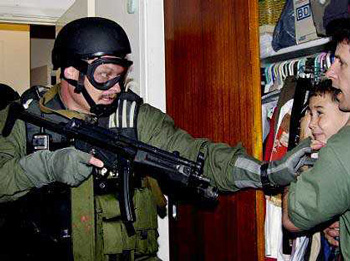
[CNN CORRESPONDENT BRIAN] CABELL: Donato Dalrymple, one of the fishermen who had rescued Elian from the Straits of Florida in November, fled with the boy to a bedroom closet when the agents burst in.
DONATO DALRYMPLE, ELIAN’S RESCUER: And I held his head next to my shoulder to try to protect him and they busted the door down. And they came in with assault weapons. I don’t know what kind they were, but it’s as if they were taking a terrorist hostage. And they grabbed the boy. And I said, “Please, don’t hurt the child. Don’t hurt the child.” [link]
When did this happen? April 2000. Kerry seems not to understand that the previous administration already set the precedent he so fears Judge Alito will bring in.
Is there anything that makes an Instalanche pale? Why, yes there is: a Rushalanche.
Gerard Van Der Leun, whom I have often praised as far more literary and literarily talented than I, had an essay of his, “The Voice of the Neuter is Heard Throughout the Land,” read on the air today by none other than the number one radio talk show host in America, Rush Limbaugh. I happened to click on the show just after he had started reading it. I remember thinking, “Hey, this is a good piece, I wonder who wrote it.” Now I know and am unsurprised.
After you’ve read (or listened to) Gerard’s essay, read, “The Pathetic Last Children of Nietzsche’s Pitiable Last Men” at One Cosmos blog. I would also recommend my essays,
“Wishy-washy” Christianity driving old-line Britons to Islam.
At the opening of the first part of this two-part series, I wrote,
Once in awhile it’s fun to do some thought experimentation. I mentioned a few days ago that I was mulling over the similarities between the counterinsurgency problem in Iraq and how the American, Canadian and British navies finally defeated the U-boat threat in World War II.
The first part consisted of a short history of the Battle of the Atlantic of World War II, the most crucial campaign of the European war.
Here I’d like to explore what similarities, if any, the present insurgency in Iraq bears to the U-boat campaign of WW2, and what lessons, of any, can be learned for counterinsurgency from the tactics the Allied navies in winning the U-boat war.
Tacticians have written for many years of the similarities between war at sea and land war in deserts. Apart from the basic flatness of terrain, though, the counterinsurgency fight (COIN) in Iraq can’t bear the kind of direct comparison that conventional combat in the desert between conventional formations can uphold. Instead, COIN is a series of small-unit actions for which intelligence and precision are paramount. As well, psychological operations play a role in COIN that was had no part in antisubmarine warfare (ASW) of WW2.
Nonetheless, I think there are similarities between the insurgency and the U-boats. Like the U-boats, the insurgents are outnumbered by their foes. Even using wolfpack tactics, U-boats only rarely achieved numerical parity against warships. However, if the insurgents and U-boats alike were outnumbered by an armed opposition, they also always are (were) outnumbered by possible targets. During convoy ops, escort commanders found it was impossible to guard all approaches to the convoy at the same time. Similarly, allied commanders in Iraq cannot guard every possible target against insurgent attack, especially against suicide-bomber attack.
U-boats were able to escape detection, in the main, by submerging under the sea. Insurgents also attempt to “submerge” into the population by dress, language and using ordinary means of transportation. This tactic, of course, is by no means original to the Iraqi insurgents. Mao tse-Tung famously wrote that guerillas are fish that swim in a sea of people, so even my sea-war metaphor for insurgency is not original with me.
I recounted I part one how intelligence, technology and direct attack techniques formed the troika that turned the tide in the U-boat war. I say as well that these three items are key in counterinsurgency. But before addressing them, it would be well to point out some big differences between ASW and COIN.
In the Battle of the Atlantic there was obviously no concern for collateral damage. The only victims were fish, and their fate was of course never considered. So there was a liberty for attacking U-boats that is not found for attacking insurgents in Iraq.
The target of ASW efforts was the U-boat itself, the naval vessel. It was the destruction of the submarine that Allied ships sought, not the destruction of the U-boat’s crew, per se. At least 75 percent of German U-boat personnel died in the war; of the U-boat crews who actually saw battle the percentage is certainly more than 90 percent, according to former U-boat captain Herbert Werner. But killing sailors was not itself the object for it was the U-boat machine that was lethal to Allied vessels and so the U-boat machines themselves that were the real targets. Of course, a U-boat imploding at 250 meters or more beneath the sea carried the crew to the bottom with it and U-boats that, mortally wounded, managed to surface were almost always ferociously attacked. Nonetheless, it was not lack of crews that finally ended the capability of the German navy to wage undersea war after 1943, it was the lack of submarines.
That being said, the destruction of crews did matter in one important regard. Naval historians have pointed out that U-boat captains were like fighter pilots in that a small number of both accounted for the majority of kills. The US Navy and US Army Air Corps made a habit of bringing high-scoring aces home to teach new pilots and offer their expertise developing new aircraft; America’s ace of aces, Richard Bong, 40 aerial victories, died test flying a new aircraft. In all air forces, aces who scored five or more victories accounted for perhaps 80 percent of kills. The Luftwaffe’s relative percentage was even higher because it did not withdraw high scorers from battle to train new pilots. The number one fighter ace of all time, in any air force, was Luftwaffe pilot Erich Hartmann, who had 352 confirmed kills against the Soviet air force. The Soviets finally adopted a tactic of identifying skilled aces and forming their tactics around individual ace’s abilities. Sometimes whole squadrons of fighters would be assigned to support the attack of a single Soviet ace!
Herbert Werner recounted in his book of the U-boat war, Iron Coffins, that when the high-scoring U-boat commanders such as Korvettenkapitän Gunther Prien began to be lost, the U-boat flotilla’s scores of Allied tonnage sunk began a steep decline, even before U-boat losses themselves mounted.
The Allied navies made no concerted effort specifically to find U-boats commanded by top commanders, even though the top commanders were easily identified along with their U-boats. U-boats were, for the Allies, always targets of opportunity and they were attacked with fury wherever they appeared.
So to the troika of intelligence, technology and attack should be added the deaths of key enemy commanders.
Because locating insurgents and U-boats alike is so difficult, intelligence always plays the predominant role. Neither insurgents nor U-boats could be targeted unless Allied operators knew where they were. For this purpose, signals intelligence plays the leading role. However, insurgents enjoy an advantage that U-boats never did: the ability to hand carry orders or information to one another. U-boats could receive orders only via radio but insurgents can, and do, send paper orders to one another via courier.
Yet that permits a tactic that as far as I know was never employed by Allied naval commanders in the U-boat war, even though it could have been attempted: the insertion of bogus communications. I don’t know whether Coalition intelligence operatives are trying to cause disarray and distrust among insurgents by inserting “chaff” into their communications chain, such as false orders, bogus missives or poison-pen letters; I would guess they are.
There is another huge advantage that the Coalition has over WW2 ASW: the fish would never fink out a U-boat, but they do fink out insurgents. Remember, according to Mao the fish are the people, on whose support (voluntary or not) the insurgents depend. But the people of Iraq are finking out al Qaeda insurgents with a frequency that has been rising across the country for a year, and finking our even Iraqi insurgents with increasing vigor as well. Iraq the Model reports, for example,
The Anbar tribes’ campaign to rid the province of Zarqawi’s terror organization, al-Qaeda in Iraq is in its 2nd day and so far, 270 Arab and foreign intruders have been arrested.
[…]
Usama Jad’aan, the leader of Karabila tribes in Qaim told al-Hayat that “the operation will continue to eliminate terror elements according to a quality plan” and added “270 Arab and foreign intruders have been arrested, in addition to some Iraqis who were providing them shelter”.Sheikh Jad’aan added “the operation is conducted in coordination between the tribes and the minister of defense Sa’doun al-Dulaimi and since we arrested hundreds of terrorists, I don’t expect the operation to take a lot of time”.
After my Marine son’s firefight of Jan. 12, in which (I infer) he and his fellow Marines killed about three dozen insurgents, he told me that the Iraqi people in his sector are turning in the bad guys more and more. Most of their successes nowadays are actually gunfire free, such as the raids he took part in on Christmas day.
One effect of this increasing amount and quality of intelligence is that the insurgents are suffering key losses they cannot replace, just as the U-boat flotilla did. Unlike during the U-boat war, Coalition forces are specifically targeting key enemy personnel. Every time a senior terrorist leader is captured or killed, or a skilled combat leader or bomb maker is removed from action, the chances of future successes fall more than mere numbers would indicate. More than any other kind of land warfare, insurgency is personality driven. America can replace a division commander much easier than al Qaeda can replace a first-rate super-cell commander.
Part of the Allied intelligence effort in the Atlantic was what we would today call combat information. Reconnaissance and target detection were essential to finding U-boats and lining them up for attack. The B-24 Liberator bomber was the manned equivalent of today’s Predator armed UAV; the Liberator with a crew of 10 carried the electronic means to find U-boats and the weapons to attack them. In Iraq, when intelligence identifies locations of likely terrorist activity we have the technical means to surveil the area day or night for days on end and attack terrorists in real time. Furthermore, “battle hand off” with fully integrated electronics among different platforms is a reality, just as Allied ASW squadrons seamlessly relived one another when a U-boat was located and attacked.
“Intentional lethality.” One of the ways the Allies turned the tide in the U-boat war was the command decision to attack U-boats ruthlessly with the aim of sinking them, however long it took. Beforehand, warships principally intended to spoil the U-boats’ attacks against convoys. Likewise, once terrorists and their cells are identified they must be targeted with the idea of removing them from battle permanently. This doesn’t always mean lethal attack; capture is just as good and often better from an intelligence perspective. It does mean, though, the ruthless pursuit against insurgents should be a central tactic.
However, unlike the U-boats, there is more than one variety of insurgent. Al Qaeda foreigners are the deadliest and most active, but also the smallest group. Baathist and Sunni insurgents form the majority of the insurgency and this fact requires some finesse. Politics also complicates COIN in Iraq in ways that did not pertain in the U-boat war. Although the sovereign Iraqi government is willing to kill Iraqi insurgents when and where necessary, it would much prefer them to abandon the insurgency. Unlike the U-boat war, there is present in the COIN fight in Iraq elements of civil war. This is a major difference that shapes the battle in ways that should not be underestimated.
The same troika, intelligence, technology and attack, that served Allied naval commanders so well against U-boats in World War II is still at work in fighting insurgents in Iraq. To it we should add the intentional targeting of key insurgent commanders. Another advantage COIN commanders have over their ASW predecessors is that the sea was neutral in the Battle of the Atlantic, but the sea of people in insurgencies is not neutral. The people always take one side or the other. Today the insurgents are having to cope with an increasingly hostile sea in which to submerge for protection.
Norm Geras has an outstanding blog. An atheist, Marxist professor at the University of Manchester, he has strongly supported the liberation of Iraq and the toppling of Saddam’s regime, usually to the dismay of his fellow travelers. He also has been profiling bloggers for a few years and profiled me on Dec. 31, 2004.
Today Norm emailed me to call my attention to an online debate he’s had with his friend an fellow atheist Ophelia (no last name given) in which they argue about the merits, if any, of religion. Ophelia argues that whatever good may be exhibited by relious people or institutions is overwhelmed by the bad.
The reason I… am not much inclined to talk about ‘the good in religion’ is because it comes at a price, and the price is too high. The good is inseparable from that price, you can’t get the good without the price, so if you think the good is not worth the price - then for you it is not a good. It can’t be a good because it’s so tangled up with the price - with the bad.
It’s not as if you can make two lists, good, bad, and judge each in isolation. Because the basic problem with religion, the thing that makes people like me adopt a fighting stance, is that it’s not true. That’s not just some minor or detachable problem that one can compartmentalize or bracket - it’s right smack in the middle.
It’s a corruption, a surrender, an abdication, and we don’t make it because - we don’t want to endorse a lie. That’s why.
But this is a silly proposition as Norm recognizes. Ophelia objects to religion because - she claims - it’s not true. But she simply makes a propositional claim that amounts to nother but her own opinion of what is true and what it not. There is no reason whatsoever that I should accept her standards of truth. She’s angry, she admits, that some people believe things she does not. Well, phhtt to her. So what? It might profit her to examine just why billions of people have throughout history affirmed various religious truths, but that would doubtless force her to admit that therer are smart people who don’t agree with her, which I imagine Ophemlia would find psychologically untenable.
In response, Norm says,
Here I am, lifelong atheist, going out to bat for religion once again - actually, not for religion, since I do not think there are valid grounds for religious belief, but against unbalanced forms of rejection of all that religion stands for and some of the values it may embody for its adherents. …
[Ophelia’s] move is artificial and arbitrary. You can’t show that religion is all bad simply by focusing on what is bad about it.
Here is a simple, and for me decisive, example. In Warsaw in 1943, a Polish Catholic risks her life to save an endangered Jew. She does so because she has been taught from childhood that all people are the children of God and it is a sin to take innocent life. How, in the face of that - which has happened plenty, and in many other historical variants as well - can one say there has been no good in religion, or that this good is merely apparent because of what it is mixed together with? I could give more than this, but it is enough. Just two things: that religious believers have often been motivated by their beliefs to act in beneficent, caring, selfless, heroic ways; and that there are universalist variants of religious belief which, in historical context, have marked a significant progress for humankind - that is quite enough empirically, against the notion that the bad in religion undoes the good.
Now, I agree with Norm’s argument, as far as it goes. He claims, successfully I think, that Ophelia’s argument doesn’t hold up, that bad practice of religion overwhelms the good. He continues,
Someone in Ophelia’s comments box - Kate - writes in this regard:
[T]he ‘good’ usually ascribed to religion is readily available outside of religion, while the ‘bad’ of religion is something that can only take place when large numbers of people are convinced that abandoning reason and abdicating personal responsibility is a virtue.
But this obviously fails.
Yeah, it fails, darn right. It fails not least because it’s pure hogwash. I readily admit that religionists of various tripes have done an awful lot of bad, some of them Christian and some of them not. But why do Norm’s interlocutors focus so much on the bad and so little on the good? Maybe it’s because atheism has never yielded any good, certainly not any good comparable to that of religion.
At the bottom of the right-hand column of my site is an ad for United Methodist Committee on Relief’s drive to help the victims of Katrina. UMCOR did the same for the victims of the Indian Ocean tsunami of late December 2004. The Salvation Army, Catholic Charities, Southern Baptists, you name it and those religious people pitched in to help.
And the atheists’ coordinated effort to help stricken people? Did we miss it somehow? Nope, there wasn’t any.
In my city there is a Baptist Hospital (in which I was born, actually) and a St. Thomas Hospital, founded and supported by the Roman Catholic Church. And the Atheist Hospital is where? Right: there ain’t one.
There are countless examples of people of religious faith joining together and being deeply involved in making better the lives of human beings around the world. Before atheists scoff at us perhaps they’d like to ponder and explain why they don’t.
My personal opinion is that the heart of every atheist is filled with the fear, indeed the deep suspicion, that they are wrong.
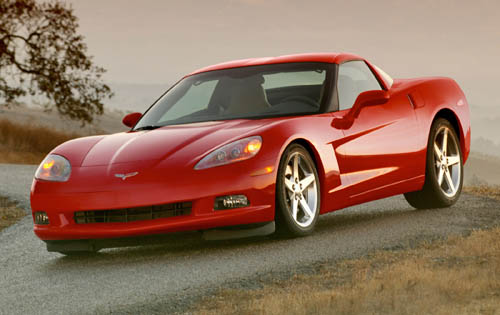
You’re a classic - powerful, athletic, and competitive. You’re all about winning the race and getting the job done. While you have a practical everyday side, you get wild when anyone pushes your pedal. You hate to lose, but you hardly ever do.
Glenn Reynolds, whence the link, owns a Mazda RX-8 and suprise! that’s what kind of sports car he is. Of course, his RX-8 is my doing, but has he ever acknowledged my beneficence? Noooooooo….
In case you haven’t been by in awhile, Bill Quick’s site, Daily Pundit, has a clean new design that looks great. The rest is still classic Bill.
Michael Silence explicates on how profoundly the former national director of the National Security Agency, Gen. Michael Hayden, does not know the terms of the Fourth Amendment to the US Constitution.
A United Methodist bishop told a congregation of Methodist worshipers in the nation’s capital that that the United Methodist Church “stands behind” the Methodist president “100 percent (and) supports your policies as they relate to the ongoing development of our country - especially your pronouncement on the fight against corruption.” The bishop said that Methodists around the world celebrated the president “not only as a United Methodist but a person of faith and integrity and deep commitment to serve all of God’s people.”
“God has given us a new leader,” said Bishop John Innis.
All true. Details here. The Methodist president in question is Ellen Johnson Sirleaf, president of Liberia and the first female president of any African country.
MONROVIA, Liberia (UMNS) - God has given Liberia a new leader, and it is the church’s responsibility to “surround her with a new heart for our nation,” said the country’s United Methodist bishop.
Bishop John Innis, who leads Liberia’s 170,000 United Methodists, urged support for President Ellen Johnson Sirleaf during a worship service the day before the inauguration.
“You are going to be a sweet mother to us all,” he told her a few days later, when a delegation of United Methodists from the United States and Liberia met with the new president on her third day in office.
“I want to assure you that the United Methodist Church here in Liberia and worldwide stands behind you 100 percent (and) supports your policies as they relate to the ongoing development of our country - especially your pronouncement on the fight against corruption,” he said.
Sirleaf, a member of First United Methodist Church, Monrovia, spoke many times of her faith when she delivered her inauguration address Jan. 16. She vowed to make corruption “enemy No. 1″ in her administration. She is the first woman to be elected head of state in Africa.
Innis, United Methodist bishop of Liberia, spoke Jan. 15 to an overflow crowd gathered at First United Methodist Church for Sirleaf’s thanksgiving and intercessory service. Also at the service were Bishop Peter D. Weaver, president of the denomination’s Council of Bishops, Bishop Joseph C. Humper, Sierra Leone, and retired Bishop Arthur F. Kulah, Liberia.
It’s safe to say that no United Methodist bishop would have led, or would have dared to lead, an American Methodist congregation in a similar service just before George W. Bush’s inauguration.
“Today, fellow Liberians, God has given us a new leader,” Innis said in his sermon, “a mother, whom I believe has a gracious and kind heart, ever willing to lead Liberia forward, by God’s command. It is therefore our responsibility to surround her with a new heart for our nation, and thus press forward with a movement for sustainable development.”
President Sirleaf’s commendable choice of denomination aside, if she is truly dedicated to “sustainable development” she will leave Liberia no better off, economically, when she leaves office than it is today. “Sustainable development” is codeword for “government control” of the economy by elevating the environment above human welfare. It’s another first-world concept that, when shoved onto African economies (say, by these guys) amounts to global racism. The Liberians have all the “environment” they can use. It’s prosperity they need but it is prosperity that “sustainable development” will shut out. How sad that President Sirleaf has apparently drunk the environmentalist kool-aid.
Glenn Reynolds says, “I thinks it’s probably okay to question Joel Stein’s patriotism.” Stein, bereft of moral sensibility, writing in the LA Times, demonstrates the vacuity of the American Left. You may recall that painting soldiers as victims has been the Left’s mantra since the later years of the Vietnam war. (To the Left, of course, every war is Vietnam.) I wrote about this almost two years ago.
Now Stein has dumped even the mantra of troops as victims. To him, troops are now to be considered willing, eyes-open conspirators of and cooperators with the imperialistic Bush administration.There is a certain meme among many members of the Left to “support the troops” while working to destroy what the troops have accomplished. But supporting the troops has another curious twist, that the troops are hapless victims.
Take Andy Rooney, for example. It seems that to Andy, supporting the troops means to denigrate their sacrifices and professionalism and to bestow on them not the mantle of heroism, but of victimhood.
Above all, it means to bring them home from the war and keep them out of combat. After all, says Andy, that all they really want. Note to Andy: all soldiers in every war want to go home.
To Andy and the most of the rest of the Left, “supporting the troops” doesn’t really mean keeping them out of combat. It means to keep them out of combat that the Left doesn’t approve of. Liberation of Iraq: bad. Killing Somalis or bombing Serbs: good. The Left is not anti-war, it simply opposes wars that seem to serve America’s interests.
No one on the Left, certainly not Andy Rooney, has demanded yet that the troops be brought home from Bosnia because, after all, coming home is what the troops want to do.
But when you volunteer for the U.S. military, you pretty much know you’re not going to be fending off invasions from Mexico and Canada. So you’re willingly signing up to be a fighting tool of American imperialism, for better or worse. Sometimes you get lucky and get to fight ethnic genocide in Kosovo, but other times it’s Vietnam.
Stein’s moral emptiness in this haphazard, ill-organized essay is demonstrated here. Stein isn’t against killing, mind you, as long as the people being killed aren’t threatening the United States. (He even accuses pacifists of being wusses.) Fighting ethnic genocide in Kosovo is imperialism, understand, but it’s “lucky” imperialism and therefore apparently quite okay.
Like almost everyone of the Left, Stein substitutes (poor) wit for wisdom and thinks that scoring verbal barbs is the same as proffering deep insights.
The truth is that people who pull triggers are ultimately responsible, whether they’re following orders or not. An army of people making individual moral choices may be inefficient, but an army of people ignoring their morality is horrifying. An army of people ignoring their morality, by the way, is also Jack Abramoff’s pet name for the House of Representatives.
We’re all enlightened now, aren’t we?
But don’t worry: Stein is a just as brave a man as those fighting imperialistic wars.
I know this is all easy to say for a guy who grew up with money, did well in school and hasn’t so much as served on jury duty for his country. But it’s really not that easy to say because anyone remotely affiliated with the military could easily beat me up, and I’m listed in the phone book.
Gosh, the man’s courage just makes me weep.
Update: Mudville Gazette has some sharp contrasts between Stein and some incredible men and women who do what Stein says he won’t: support the troops.
Despite a period yesterday when I thought I could pull up to at least a tie, it has proved not to be so. See you Monday.
Do you think for a fraction of a second that the MSM might, just might, give even half the coverage they gave Cindy Sheehan to Bud Clay? Nope, I didn’t think so, either.

| S | M | T | W | T | F | S |
|---|---|---|---|---|---|---|
| « Dec | Feb » | |||||
| 1 | 2 | 3 | 4 | 5 | 6 | 7 |
| 8 | 9 | 10 | 11 | 12 | 13 | 14 |
| 15 | 16 | 17 | 18 | 19 | 20 | 21 |
| 22 | 23 | 24 | 25 | 26 | 27 | 28 |
| 29 | 30 | 31 | ||||
17 queries. 1.278 seconds